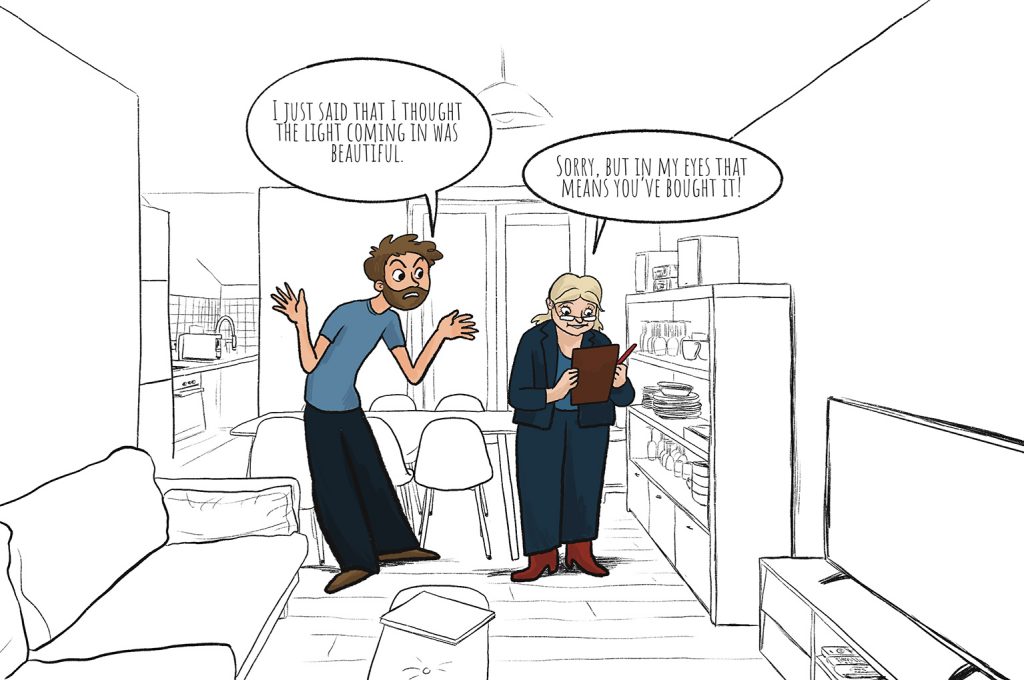
The sale of real estate rarely occurs without legal nuance. This is once again demonstrated by a recent ruling of the Ghent Court of Appeal dated June 4, 2025. Hereby, the court rules that an offer from a prospective buyer, despite being accepted by the seller, does not automatically result in a definitive sale nor does it give rise to a claim for a broker’s fee.This decision underscores the importance of clear agreements regarding the conclusion of a sale and the conditions under which a brokers” fee becomes due.
1. Facts and Court’s Ruling
In the case at hand, a real estate broker transmitted an offer from a prospective buyer to the seller. The offer was accepted by the seller, but the private sale agreement was ultimately not signed. The broker nevertheless claimed commission, arguing that the acceptance of the offer sufficed to establish a valid sale and thus to obtain payment of the commission.
However, the Ghent Court of Appeal ruled otherwise.
According to the Court, the signing of a private sales agreement was an essential condition for the conclusion of the sale and not merely an execution modality.
The court noted that the offer contained a clause requiring the signing of a private deed within a period of 14 days, namely: “The signatory is aware that upon agreement by the counterparty (buyers or sellers) within the period mentioned above, they will in any case be obliged to sign the definitive sales agreement within 14 days…”
The court questioned how this provision should be qualified.
According to the court, the signing of a private deed can constitute either an execution modality or a substantial condition.
In the latter case, there is only a binding sale once the parties have signed a private deed.
The court also found that the offer mentioned the signing of a ‘definitive’ sales agreement, which indicates that the accepted offer did not create a definitive contract and that further negotiations were necessary to reach the actual agreement. The obligation to conduct further negotiations is an obligation of best efforts, not an obligation of result.
In this regard, the court also noted that (to the extent the offer was made under the suspensive condition of obtaining a loan, which was not the case here) the deadline for such proof – whether or not a loan is obtained – does not start from the acceptance of the offer, but rather from the signing of a sales agreement, which supports the above finding.
The court clarified that there was only an intention to further negotiate, without a definitive sales agreement being concluded. Because the sale was not realized, and this was beyond the seller’s control, the agent could not claim a commission.
The court considered it particularly relevant that the clause concerning the signing deadline and payment could not be regarded as a mere formality, but as a decisive condition for the formation of a valid contract.
2. Practical Impact for Real Estate Brokers?
This ruling confirms that an accepted offer does not automatically equate to a binding sale. For real estate brokers, this means they must clearly define their contractual arrangements with sellers, including the conditions under which commission is earned. In this case, a commission was only due when the definitive sale was concluded, which, based on the description of the offer, only occurred after the signing of the private agreement.
Whenever an offer contains suspensive conditions (e.g. the obtaining of a regularization permit or a loan), or when the signing of the sale agreement is explicitly required, caution is warranted. Brokers must also communicate transparently with their clients about the precise moment their fee becomes due, in order to avoid disputes.
3. Conclusion
The ruling of the Ghent Court of Appeal serves as a useful reminder that not every (accepted) offer results in a sale and that the right to brokerage commission remains dependent on the specific circumstances and contractual provisions. Both real estate brokers and sellers benefit from careful documentation and clear agreements when conducting real estate transactions.
You can find the full text of the decision in the latest issue of Res et Jura Immobilia.
Follow this link: https://www.anthemis.be/shop/res-et-jura-immobilia-abonnement-16750?category=153#attr=17241,17554
For a comprehensive overview of the legislation governing the real estate sector in Flanders and Brussels, you can consult the new “Vastgoedcodex”, published in collaboration with KnopsPublishing.
Buy a copy (print or download – Dutch) here: https://nl.knopspublishing.be/shop/boeken/burgerlijk-recht/vastgoedcodex-vlaanderen-brussel-2025-2026/
💡 Need assistance with drafting a comprehensive model of an offer, private deed, or legal advice on real estate transactions or brokerage agreements in general?
Feel free to get in touch. Andersen’s Real Estate team is happy to assist you further.
Ulrike Beuselinck (Partner – Mediator)