I. What was the case about?
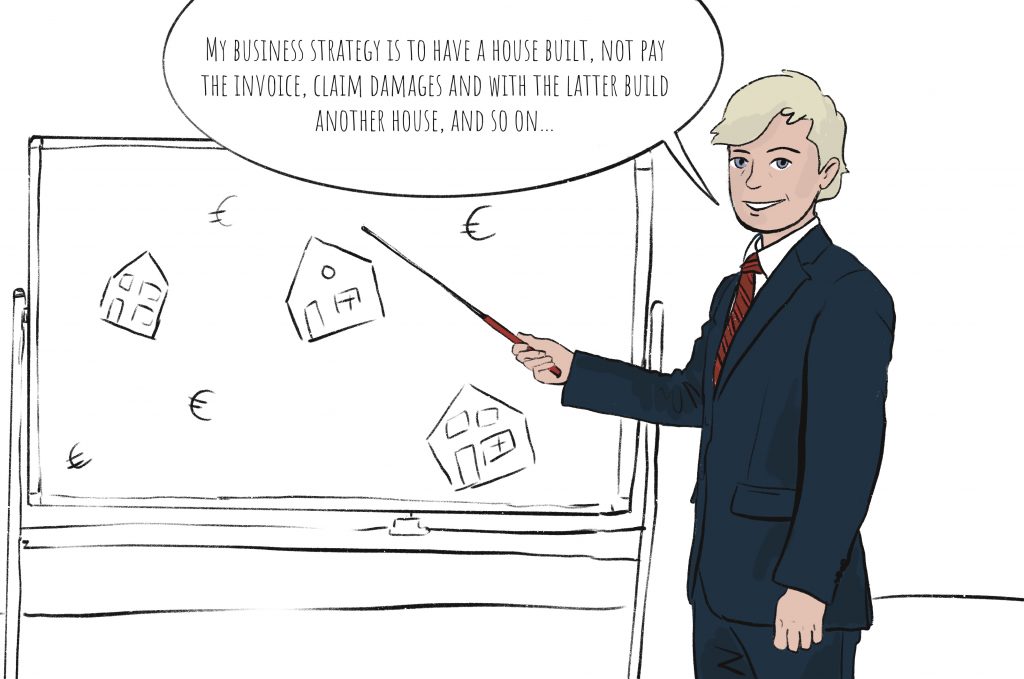
A contractor was engaged to carry out a building project for an agreed contract price of almost €300,000. The developer later discovered defects, including a leaking roof and an inadequate concrete floor, and therefore refused to pay the outstanding balance of approximately €29,348.22.
The court of first instance held that the developer was entitled to damages of €19,579.04 and at the same time rejected the contractor’s claim for payment of the invoice balance. The Antwerp Court of Appeal confirmed that decision.
The contractor brought the case before the Court of Cassation, arguing that refusing to pay the invoice and awarding damages amounted to double compensation for the same loss, thereby breaching the principle of full (but not excessive) compensation.
The Court of Cassation quashed the Antwerp judgment. It accepted the contractor’s argument and found that the appellate court had awarded the developer more than the actual loss suffered, thus infringing Article 1149 of the former Civil Code.
II. What does the judgment mean?
Under the principle of full compensation a debtor must make good the loss resulting from a faulty non-performance of a contractual obligation. That loss includes both actual loss and loss of profit and should place the creditor in the position he would have been in had the obligation been properly performed.
Where a contractor performs defectively, the developer may therefore in principle claim full compensation for the loss sustained.
Crucially, the Court re-affirmed that a creditor may not at the same time:
- obtain damages for loss caused by the breach, and
- continue to withhold his own contractual performance (such as payment) on the basis of that same breach.
Such cumulation would amount to double compensation and therefore to over-compensation, contrary to the principle of full reparation.
III. Practical implications for construction practice
A developer faced with defective works may not both refuse to pay the outstanding contract price and claim damages for those very defects, unless he strictly applies the correct legal basis:
- Defence of non-performance (exceptio non adimpleti contractus) – the owner may suspend payment temporarily while the contractor remains in default, provided the strict conditions for this defence are met.
- Compensation – the developer may set an established damages claim against the outstanding invoices, so long as the damages are certain and compensation is not contractually excluded.
If the defects do not justify termination, the developer can also claim a price reduction. A price reduction adjusts the contractual balance and is distinct from damages; it cannot normally be combined with other compensatory measures.
IV. Concluding remarks
With its judgment of 8 November 2024 the Court of Cassation puts an end to lingering uncertainty about the reciprocal rights and duties arising from defective performance in construction contracts.
The ruling upholds the logic of contractual balance: loss must be made good fully, but no more than fully. Contractors keep their right to be paid for work done, even when liable for defects—so long as that payment does not conflict with a properly established compensation or price reduction.
For developers and contractors alike this means: draft clear contracts, apply the rules on compensation correctly, and above all avoid pursuing “double recovery” before the courts.
For a comprehensive overview of the legislation governing the real estate sector in Flanders and Brussels, you can consult the new “Vastgoedcodex”, published in collaboration with KnopsPublishing.
Buy a copy (print or download – Dutch) here: https://nl.knopspublishing.be/shop/boeken/burgerlijk-recht/vastgoedcodex-vlaanderen-brussel-2025-2026/
💡 Need assistance with drafting a comprehensive model of an offer, private deed, or legal advice on real estate transactions or brokerage agreements in general?
Feel free to get in touch. Andersen’s Real Estate team is happy to assist you further.
Ulrike Beuselinck (Partner – Mediator) & Emilie Javid Milani (Senior Associate)